

Hello, BÜRK community! If you’ve ever stared at a pickleball court and thought the players were doing a strange dance on the serve, you’re not alone. They haven’t forgotten where they stand; they’re using stacking, the pros’ favorite strategy for dominating the net.
“We will turn the center of the runway into an impenetrable wall.”
What the hell is stacking?
Stacking is a doubles positioning technique where players are positioned so that, after the serve or the return, each player always ends up on his or her preferred side of the court.
Normally, the rules require you to change sides every time you win a point with your serve. But with stacking, we “cheat” the rule: we comply with the place from where it is our turn to serve according to the scoreboard, but we move immediately so that the player with the better forehand stays on the left side.
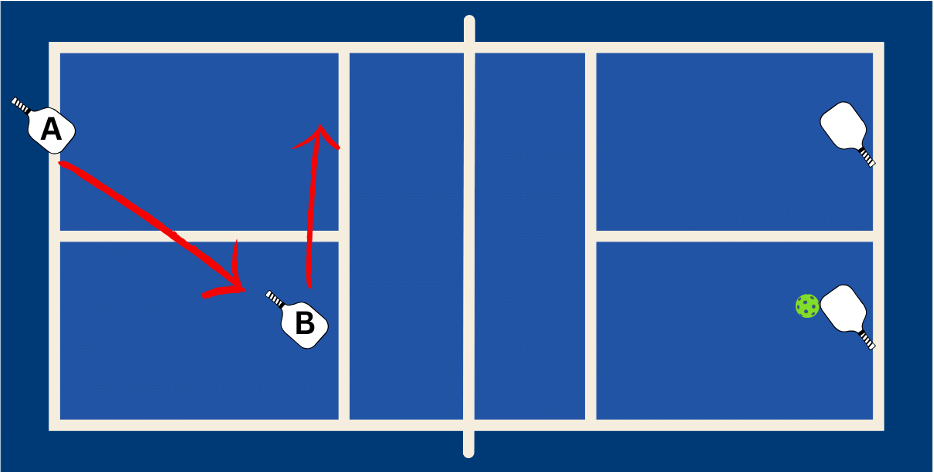 https://www.thedinkpickleball.com
Why should you start stacking?
It’s not just for professional posturing. It has its advantages:
- Center forehands: In pickleball, most of the attacks go down the middle. Stacking allows the right-handed player to play on the left and the left-handed player (if necessary) on the right, putting two forehands in the center. We will turn the center of the court into an impenetrable wall.
- Hiding weaknesses: If one of you has a weak backhand or less mobility, stacking allows you to “protect” it by placing it where it will do less damage.
Mixed Pairs (Lefty/Righty): If you play with a lefty, stacking is almost mandatory to maximize your offensive potential.
The Golden Rule: Even and Odd
To avoid committing a foul, you must remember your starting position in the match:
- Even points (0, 2, 4…): The player who started the set on the forehand must serve or subtract from the forehand.
- Odd points (1, 3, 5…): That same player should be on the left.
The technical trick: It only matters that the server and receiver are in place at the moment of impact. Their teammates can be anywhere they want, even off the court so as not to get in the way of the movement.
Secret language: Hand signals
Because at BÜRK we like precision, you can’t just go for broke. Communication is key. The player at the net signals to the subtracting player (usually behind his back so the opponent can’t see him):
- Open hand : It means “Switch”. As soon as the ball is hit, we cross positions.
- Clenched fist: Means “Stay”. We maintain the current positions for this point.
- Amago: The most advanced use signals to “fake” a change and confuse the opponent, forcing them to miss the shot by hesitating.
“If you’re accurate and get the ball in there just as they’re crossing, the point is yours.”
Types of Stacking: Half or full?
Not all couples apply stacking in the same way. Depending on your comfort and mobility, you can choose between these two modalities:
- Half Stacking
It is the ideal option for teams that are just starting with this technique. It consists of stacking only the service.
 https://ppatour.com
- Why do it? It is much easier to execute and you take less risk. When you serve, you have control of the timing and it is more difficult for the opponent to catch you off guard in transition.
- BÜRK tip: If your score is odd and you have to serve from the “wrong” side, place both of you in the same box. The server only has to move laterally after the hit to recover his preferred side.
- Full Stacking
This is where the choreography becomes professional. Full stacking means that you position yourselves to play on your preferred side on every point, both serve and return.
- The challenge: Subtract and unwind is much more stressful. The subtracting player must move a longer distance while the ball is already coming back, which can leave dangerous gaps if you are not fast.
When to use it? When the advantage of having your forehands to the center is so great that it compensates for the risk of the initial run.
Bürk pickleball clothing combines comfort, lightness and elasticity to help you cover the risks of stacking explosively.
How to Counteract a Stacking Partner
If you see that your opponents play stacking, attack their weak points! At Bürk we show you how:
- Open and angled serve: If you know the receiver has to run to the other side after the serve, make the path longer. Serve for the sideline to force him out of the court. It will cost him his life to get back to the net in time.
- Attack the player on the move: The golden rule. If you see someone sprinting to change sides, throw the ball directly at their feet or into the space they just vacated. It is very difficult to return a quality shot while you are in the middle of a side sprint.
- Deep remainders: If they are stacking on the serve, throw your remainder too deep. This forces them to hit from the bottom and takes away time for them to complete their change of position comfortably.
- Vary the pace: Don’t let them get into a rhythm. Alternate strong drives with drops or even lobs to force them to hesitate in their rotation. Confusion is your best ally against stackers.
- Hunting the “corridor”: At the moment of the change, there is usually a gap (the seam) between the two players. If you are accurate and get the ball in there just as they are crossing, the point is yours.
Technical Conclusion
Stacking is a powerful tool, but it is not invulnerable. As we say at BÜRK, the key is communication and agility. If you decide to use it, practice it until the move is automatic, your level of play will go through the roof; and if they do it to you, use these tactics to punish their audacity.
Are you ready to try Stacking in your next tournament? Remember, if you need a racket that gives you that extra precision in the changes, take a look at our BÜRK Legend range. See you on the court!



 No products in the cart.