

Do you feel like your opponents are always at the net while you’re stuck at the back of the court defending as best you can? They’re not faster, they’re not more agile, and their shoes don’t have springs. The secret usually lies in the first 5 seconds of the point.
Today on the Bürk blog, we’re going to break down the tactical concept that the best coaches in the United States constantly repeat: “Return + 1.”
If you want to stop playing defensively, getting rid of balls, and start controlling the pace of the game, read on to the end. Your way of returning serves is going to change today.
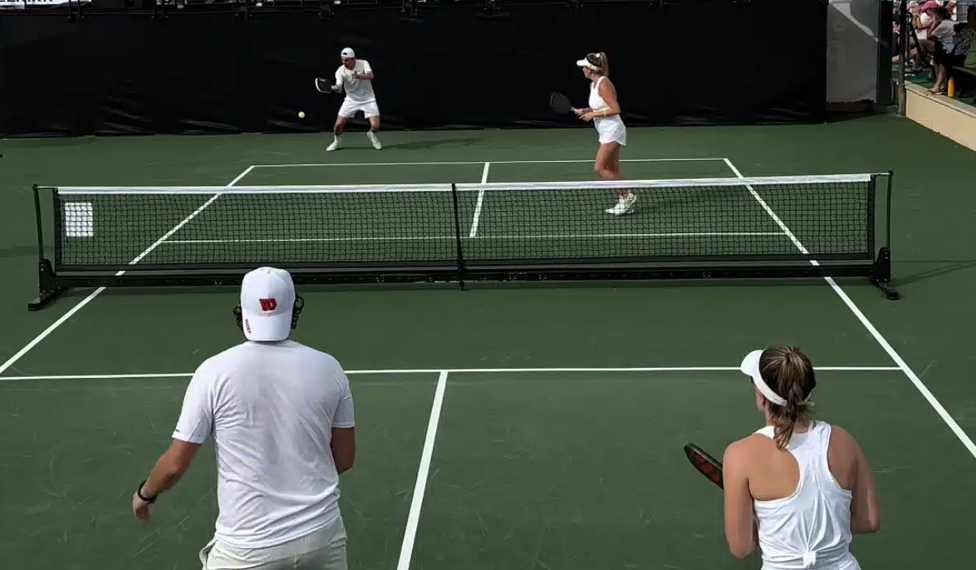
What exactly is “Return + 1”?
Many amateur players make the mistake of thinking that the return (the return of serve) is for winning the point. They look for a winner down the line or a cannonball that will destroy their opponent’s wrist. MISTAKE
In high-level pickleball, the goal of the return is not to win the point; it is to buy time. Time to position yourself well at the net.
The “Return + 1” formula is simple:
- The Return: A deep, high ball.
- The “+1”: The run immediately after the shot towards the No Volley Zone Line (the Kitchen).
Your goal is to reach that line before your opponents hit the third ball. If you succeed, you will have neutralized their serve advantage.
The 3 Keys to a Perfect Return (and how your Bürk paddle helps)
To execute this tactic perfectly, the first point is to forget about raw power. What matters here is geometry and patience.
- Look for Depth, not Speed
Imagine that your opponent’s baseline is a cliff. You want to push them towards it. Keep them away from the net. If your return bounces deep (less than a meter from the baseline), you force your opponent to back up to hit the ball, and I assure you they will start to feel very uncomfortable.
- Bürk’s tip: You don’t need to make a huge swing. Use the sweet spot of your paddle to block and push the ball gently but firmly.
- Height is your friend (the “loft”)
This is where most players go wrong, especially amateurs. We tend to want to hit low, tense, and as hard as possible. But remember: we need to buy time to run. If you hit a flat, fast return at 80 km/h, the ball will come back to you before you know it, catching you halfway in no man’s land. On the other hand, if you lift the ball with a gentle arc and clearance over the net, you will achieve two things: first, you won’t miss that return, and second, the ball will take longer to reach the back of the opponent’s court. Those extra seconds are pure gold for you to get to the net and stand your ground with authority. That’s where you’ll start to dominate the point.
- To the Center and Inside
Don’t aim for the sidelines. You increase the risk of missing the return, and the angle you open up makes it easier for them to pass you with their third shot. The safest and most tactically annoying area is the center of the court, right on the line that divides the two opponents.
- Why? Because you cause confusion (“is it yours or mine?”) and eliminate their angles of attack.
The most common mistake: “Admiring your shot”
This is the mistake we see on 90% of pickleball courts. The player hits a deep return, at just the right height, with an Instagram-worthy swing, the sunset glows on the horizon, your Bürk paddle is the perfect finishing touch, beautiful… And then they stand still for a second watching their work, seeing what the ball does, enjoying the moment. Let me tell you, you’ve just messed up.
In the “Return + 1,” your legs must activate the moment the ball touches your paddle.
- You hit (Return).
- You run (The +1).
- You stop before your opponent hits (Split Step).
If you stand there watching, you’ll be late. And in pickleball, being late to the net usually means losing the point.
The Team Matters: Control over Power
To execute a deep, high, center-placed return, you don’t need an uncontrollable wooden board. You need a paddle that gives you feedback.
At Bürk, we design our paddles with this kind of smart play in mind. Thanks to our textured surface and advanced polymer cores, you get the feel you need to put spin on the ball and place it exactly where it hurts your opponent the most: at their feet, deep in the court.
Ready to try it? Next time you step onto the court, don’t try to win the point with your return. Just place it deep, run to the net, and smile as you watch your opponents suffer from the back of the court.
Want to improve your control game? Check out our Bürk Paddle Collection and find your perfect partner to dominate every match.

 No products in the cart.